
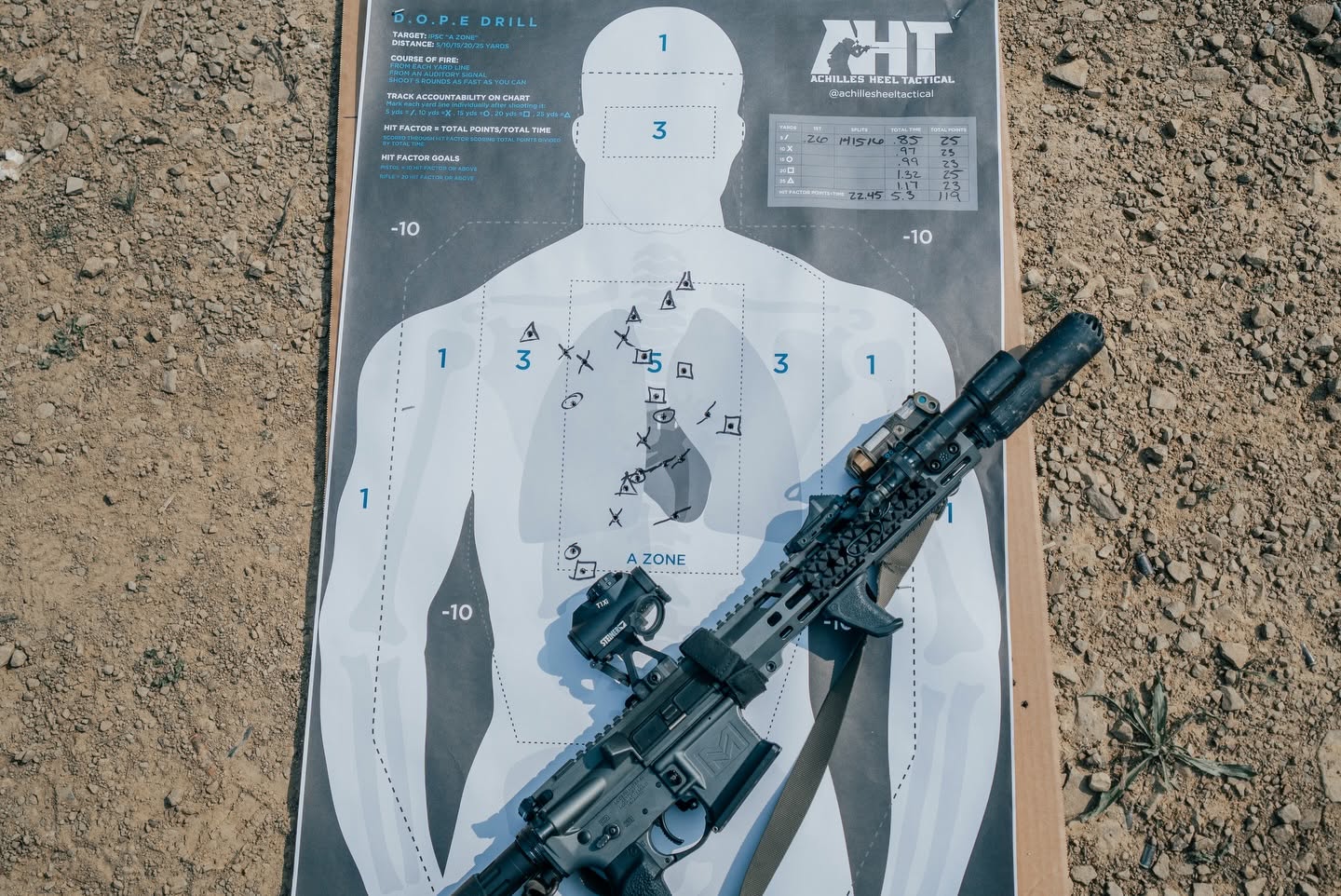
We spend a lot of time on this site talking about gear — what to buy, what to skip, what actually earns a spot in your loadout. But here’s an uncomfortable truth: most shooters can rattle off every spec on their carry pistol and can’t tell you their first-shot time from a ready position at 15 yards. They know the gun. They don’t know themselves.
There’s a drill that fixes that, and it comes out of Achilles Heel Tactical, a veteran-owned training company in central Ohio. It’s called the D.O.P.E. Drill, it takes 25 rounds, and by the time you tape your target you’ll have something most shooters never bother to collect: actual data on your own shooting.
Where the Drill Comes From
If you’ve spent any time around precision rifle shooters, you know the term D.O.P.E. — Data On Previous Engagement. Long-range guys live and die by their dope books. Every distance, every condition, every correction gets written down, so when a shot matters there’s no guessing involved.
Achilles Heel Tactical took that same logic and pointed it at practical shooting. Their lead instructor built the drill back in 2019 after moving from a military background — carbines and gas guns — into law enforcement work, where the pistol suddenly became the primary weapon. The question he needed answered is the same one every armed citizen should be asking: what can I actually do with this gun, at realistic distances, when I’m forced to shoot fast?
The drill answers that question in about ten minutes of range time. AHT breaks down the full philosophy behind it on their blog, but here’s how to run it yourself.
The Gear You Need
This is The Gear Bunker, so let’s start with the kit. The list is short, and if you’re a regular reader you probably own most of it already:
- One USPSA target. You’re scoring against the perforated A, C, and D zones, so a proper cardboard USPSA target beats a printed silhouette here.
- A shot timer. Non-negotiable. The entire drill is built on time data, and a phone app won’t cut it on a live range. If you’ve been putting off buying one, this drill is your excuse — a shot timer will improve your shooting more than the next upgrade you were planning to bolt onto your gun.
- 25 rounds of whatever you actually run, not the cheap stuff you’d never carry.
- Your pistol, your carbine, or both. The drill has separate standards for each.
- A Sharpie marker and something to log times. Notebook, phone, the back of your hand — doesn’t matter, as long as the numbers get recorded.
The Course of Fire
You’ll shoot five strings of five rounds each, at 5, 10, 15, 20, and 25 yards. That distance spread isn’t arbitrary — it covers the realistic engagement envelope for a cop or an armed citizen.
Every string starts from what AHT calls a low cover position. This isn’t a lazy 45-degree ready. The muzzle comes down far enough that your optic sits below the bottom edge of the target — no red dot hovering in front of your face, no cheated head start. Every string demands a full presentation.
At the beep, drive five rounds into the A-zone as fast as you can break acceptable shots. Log your total string time. Then walk downrange and mark that string’s hits with a distance-specific symbol — AHT uses slashes for 5 yards, X’s for 10, circles for 15, squares for 20, and triangles for 25.
That marking system is quietly one of the smartest parts of the drill. When you’re finished, one target shows you the entire story: where your accuracy held together and exactly which yard line broke it.
How It’s Scored
The drill uses hit factor scoring — the points-per-second math from USPSA competition. A-zone hits are worth 5 points, Charlies are 3, Deltas are 1, and a miss costs you a brutal minus 10. With 25 rounds, a perfect score is 125 points.
When all five strings are done, total your points, total your times, and divide:
Total Points ÷ Total Time = Hit Factor
Say you shoot 107 points across the five lines with a combined time of 5.17 seconds. That works out to a 20.69 hit factor. Run the math the other direction and you’ll see how demanding this gets — with a max of 125 points, hitting a 20 hit factor means your five strings have to total 6.25 seconds or less, out to 25 yards, from that low-muzzle start.
What makes hit factor the right tool for the job is that it refuses to let you hide. Spray fast and the misses bury you. Shoot a pretty slow-fire group and the clock buries you instead. Somewhere in between is your real skill level — and depending on where you are, giving up a couple points to gain time might actually raise your score. Learning to make that trade on purpose, based on your own numbers, is half the value of the drill.
The D.O.P.E. Drill Card
Here’s where AHT raised the stakes. They recently launched the D.O.P.E. Drill Card — a numbered card awarded to shooters who hit the standard in class, on demand, in front of an instructor:
- Carbine: 20+ hit factor
- Pistol: 10+ hit factor
No range-day do-overs, no “I usually shoot better than this.” The cards can’t be bought, and AHT estimates fewer than one in a thousand shooters worldwide could hit the number cold. Whether you care about the bragging rights or not, the card does something genuinely useful: it documents a verified baseline of what you could do on a specific day, at a witnessed standard. Data on a previous engagement, sitting in your wallet.
Why This Beats Your Normal Range Day
Most range sessions are gear evaluations disguised as practice. New optic, new trigger, new ammo — shoot a group, nod, pack up. The D.O.P.E. Drill inverts that. The gear is the constant; you’re the variable being tested.
It also exposes the gap between “certified” and “qualified.” Most qualification courses — law enforcement included — are check-the-box standards built around the lowest common denominator. They confirm you’re safe. They don’t tell you what you can do at speed, and speed is exactly what a real defensive encounter will demand.
And a bad run costs you nothing here. On the range, failure is a round in a berm and a bruised ego — cheap tuition. The drill lets you find your failure point where finding it is free.
One warning from AHT worth repeating: a baseline you never retest is a baseline you’ve lost. Run the drill, train against whatever it exposed, and run it again in a few months. It’s a recurring measurement, not a one-time certificate.
Get on the Line
You can run the D.O.P.E. Drill solo this weekend with a target, a timer, and a box of ammo — and you should. But the card is only earned in class, and there’s real value in shooting the standard cold, under observation, with an instructor who can diagnose what your target is telling you.
If you’re within striking distance of central Ohio, check the Achilles Heel Tactical training calendar and get a course on the books. Show up, shoot a 20 with a carbine or a 10 with a pistol, and walk out with a numbered card that says exactly what you’re capable of.
Most shooters have an opinion of their skill. Go get the data instead.
Stay tuned to The Gear Bunker and be a part of this all veteran-owned website. And be sure to subscribe to our Facebook, Instagram, and YouTube channels. Sign up to be notified on YouTube ensuring you’ll know immediately when new content is uploaded.
Check out our new Affiliate Partner Page.
Visit our Amazon Storefront for more related items.

Leave a Reply