
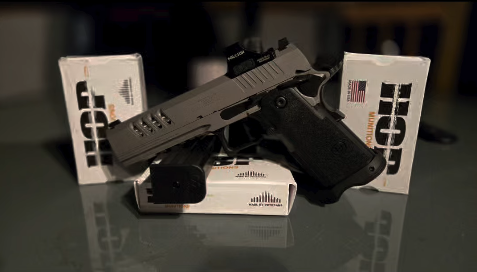
HOP Munitions White Box 9mm vs. Winchester White Box: What Do the Numbers Say?
Winchester White Box 9mm has been a range staple for decades. It is familiar, widely available, and has become something of a benchmark for basic 115-grain FMJ training ammunition.
HOP Munitions is taking aim at that same category with its White Box 9mm 115-grain FMJ, but with a notable difference: HOP is publishing velocity consistency data for the load.
That gives shooters something more useful than another claim of “consistent performance.” It gives them numbers they can actually evaluate.
Looking Beyond Muzzle Velocity
Most ammunition manufacturers publish muzzle velocity. Far fewer publish standard deviation (SD) or extreme spread (ES).
Those numbers provide a more detailed look at how consistently ammunition performs from shot to shot.
Standard deviation measures how closely individual velocities cluster around the average velocity. Extreme spread is simply the difference between the fastest and slowest rounds in the string.
In controlled testing through a 4-inch barrel, HOP reports the following results for its White Box 115-grain FMJ:
- 1,150 fps muzzle velocity
- 5 fps standard deviation
- 13 fps extreme spread
Those are tight numbers for bulk 9mm training ammunition.
Winchester lists its USA White Box 115-grain FMJ at 1,190 fps, but its product information does not publish comparable SD or ES figures.
That does not mean Winchester White Box is inconsistent. It means there isn’t manufacturer-published SD or ES data available to make a direct comparison on those metrics.
Why Does Velocity Consistency Matter?
For most defensive-pistol training inside typical handgun distances, a few feet per second one way or another isn’t going to make or break a training session.
Consistency still matters, however.
Shooters spend considerable time trying to eliminate variables from their performance. Grip, trigger control, sight tracking, presentation and follow-through are all built around repeatability. Consistent ammunition removes another variable from that equation.
That becomes particularly useful when running structured drills, tracking performance over time or simply putting a high round count through a handgun.
Velocity data isn’t the same thing as an accuracy test, either. A low SD does not automatically mean a particular load will produce the smallest groups from every handgun. Different barrels and firearms can produce different results.
What the data does provide is another measurable indicator of ammunition consistency.
HOP White Box vs. Winchester White Box
On paper, these are two very similar products: American-made, 115-grain FMJ 9mm intended primarily for range use and training.
The distinction is in the amount of performance information being provided.
| Specification | HOP White Box | Winchester White Box |
|---|---|---|
| Caliber | 9mm Luger | 9mm Luger |
| Bullet | 115-grain FMJ | 115-grain FMJ |
| Listed velocity | 1,150 fps | 1,190 fps |
| Standard deviation | 5 fps in HOP testing | Not published |
| Extreme spread | 13 fps in HOP testing | Not published |
| Box count | 50 rounds | 50 rounds |
HOP also emphasizes American manufacturing, controlled production, lot traceability and quality control as part of its White Box line.
Is HOP White Box Worth Considering?
Winchester White Box isn’t going anywhere. It remains one of the most recognizable names in bulk handgun ammunition and can be found on shelves across the country.
HOP Munitions is competing for the shooter who wants more information about what is actually inside the box.
Its 115-grain White Box 9mm isn’t being positioned as exotic match ammunition or a specialized defensive load. It’s range ammunition with documented velocity performance behind it.
The most interesting number may actually be the 5 fps standard deviation.
Shooters with chronographs know how difficult it can be to see single-digit SDs consistently, particularly from ammunition intended for high-volume training. HOP’s reported 5 fps SD and 13 fps extreme spread therefore give shooters a concrete benchmark they can test for themselves.
And that’s ultimately the more interesting comparison.
Rather than asking whether one white box is categorically “better” than another, shooters can put both across a chronograph, run them through their own handgun and see what the numbers look like.
For shooters who care about measurable consistency, HOP has at least provided a number to beat.
Check Out HOP Munitions White Box 9mm 115-Grain FMJ
Stay tuned to The Gear Bunker and be a part of this all veteran-owned website. And be sure to subscribe to our Facebook, Instagram, and YouTube channels. Sign up to be notified on YouTube ensuring you’ll know immediately when new content is uploaded.
Check out our new Affiliate Partner Page.
Visit our Amazon Storefront for more related items.

Leave a Reply