
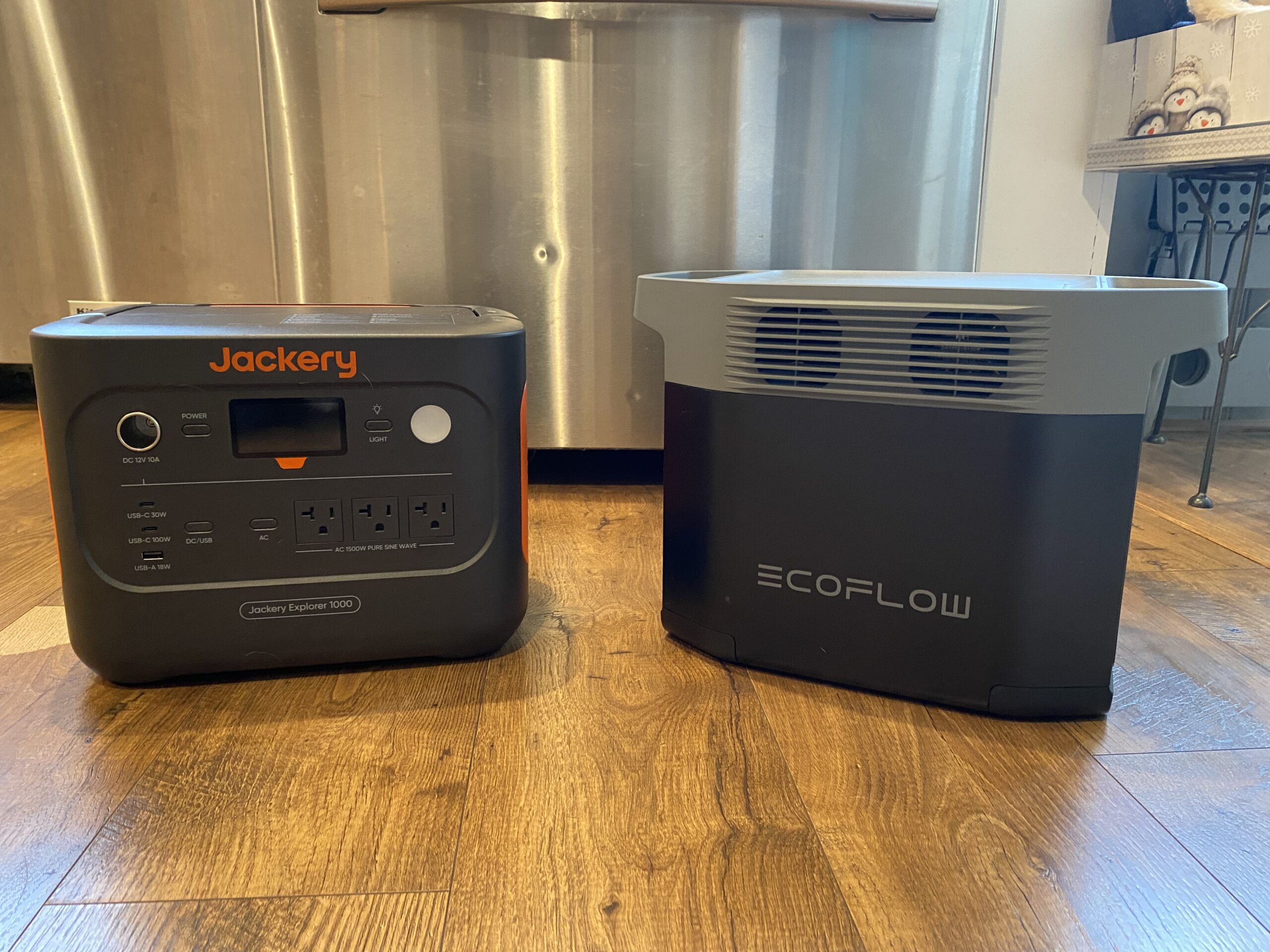
Out of the box, both the Jackery Explorer 1000 and ECOFLOW Delta 2 are quality-made products with very similar capabilities.
They both came with less than a 50% charge, so the first step was to plug them into an AC outlet to bring them up to 100%.
The Jackery Explorer 1000 arrived with a 23% charge. Once plugged in, the input wattage was approximately 238 watts, with a margin of error of ±2 watts. With about 30 minutes left, the input wattage jumped to around 480 watts. The time from 23% to 100% was roughly 1.5 hours. Not the fastest.

Designed for real-world emergency use with fast charging, high output, and a battery life rated for a decade of use.
The ECOFLOW Delta 2 came with a 33% charge. Once plugged in, the input wattage was approximately 630 watts, increasing to around 930 watts when it reached 40%. The total charge time was approximately one hour.

A fast-charging 1,800W power station built for home backup, camping, RV travel, and off-grid reliability.
Here are some quick stats for both:
Output rating
- Jackery Explorer 1000 – 1,500 running watts (3,000 watt surge)
- ECOFLOW Delta 2 – 1,800 running watts (2,700 watt surge)
Watt hours
- Jackery Explorer 1000 – 1,070 watt hours
- ECOFLOW Delta 2 – 1,024 watt hours
Battery cycle life
- Jackery Explorer 1000 – 4,000 cycles to 70%+ capacity
- ECOFLOW Delta 2 – 3,000 cycles to 80%+ capacity
The Test
The test I ran on both units was simple: power the bare minimum needed in winter to keep the furnace running, a full-size fridge, a chest freezer, and two lamps.
Both units handled it. When everything was running—compressors on the fridge and freezer, and the furnace blower—we were pulling a little over 1,000 watts, which resulted in about one hour of run time at peak wattage. The running wattage hovered around 300 watts, providing roughly 2 to 3 hours of runtime before needing a recharge.


I did have to purchase a bonded 3-prong plug that bonds the ground and neutral. That was required for the furnace to operate. Since it’s small and easy to lose, I suggest attaching a lanyard and keeping it tied to your battery backup so it’s always right there.

A neutral-ground bonding plug that eliminates “open ground” errors on portable generators so your furnace and appliances run safely and reliably during outages.
Other than that, determine how many extension cords you’ll need, select the right lengths, and keep them reserved for power outages. I suggest creating a power outage duffel bag or tote that holds all your extension cords, the bonded plug, and any other necessary items. That way, it’s always ready, and you’re not running around in the dark looking for gear.
I also have a gas generator, but it will be reserved for backfeeding and charging the battery backup unit once the battery level drops below 20%.
While both units easily supported what I needed for my house, the Jackery Explorer 1000 is the winner. It seemed to have a longer runtime under steady load. During peak wattage, both units dropped to roughly one hour of power. The Jackery does support a higher surge—3,000 watts, compared to the ECOFLOW’s 2,700 watts.
And before you all poo-poo the power strip, I checked the cord regularly. It never got warm. For a temporary solution, this setup worked perfectly and prevented me from having to drag out the gas generator in the cold for a few hours.

One nice feature the Jackery has that the ECOFLOW doesn’t is a small onboard LED light with low, high, and strobe settings. It’s a solid option when everything goes dark. As soon as you pull the Jackery out, you can flip on the LED to light your workspace while you get things plugged in. Low uses 1 watt, high uses 2 watts, and strobe uses 1 watt.
The ECOFLOW technically has more AC outlets, but only two are three-pronged. The rest are two-pronged. The Jackery offers three 3-prong AC outlets. That matters since one of those outlets will be tied up by the bonded plug, which is why I opted to use a power strip during testing.


Also, the Jackery has all its output ports on the front. The ECOFLOW has AC outlets on one side and USB outlets on the other. Not a dealbreaker, but another small win for the Jackery.
Both units support AC and solar recharging.
Now that I know both units work for my setup, I ordered a heavy-duty 12-gauge 6-foot extension cord with three outlets to replace the power strip I used during testing.

A tough, weather-resistant 12-gauge extension cord with a lighted end and three grounded outlets—perfect for safely powering multiple appliances during outages or off-grid setups.
Equipment list
- Jackery Explorer 1000 – https://amzn.to/487ttQS
- ECOFLOW Delta 2 – https://amzn.to/4oEX375
- Bonding plug – https://amzn.to/4r0OUeX
- 6 ft 12-gauge heavy-duty extension cord – https://amzn.to/4r3DQgS
Combine one of these units with the following ventless gas heaters, and you’ve got yourself a bombproof system throughout the winter if the grid goes down.
Natural Gas Space Heaters: Reliable Backup Heat for Fall and Winter

Stay tuned to The Gear Bunker and be a part of this all veteran-owned website. And be sure to subscribe to our Facebook, Instagram, and YouTube channels. Sign up to be notified on YouTube ensuring you’ll know immediately when new content is uploaded.
Check out our new Affiliate Partner Page.
Visit our Amazon Storefront for more related items.

Leave a Reply